
Top 5 Free Google Courses With Certificate in 2026
Imagine that.
Two students decide to sit on the same day and take the same free course offered by Google. Six months pass. One of them has got the certificate, the portfolio project and the job interview lined up. The other has got the half-done notes, three tabs closed and a vague plan "to get back to it next week."
Same course. Different results.
It was not because of their intelligence. Not because of the amount of time. It was a matter of understanding the importance of the course, having the plan to complete it and being aware of how to remain consistent in a world full of distractions.
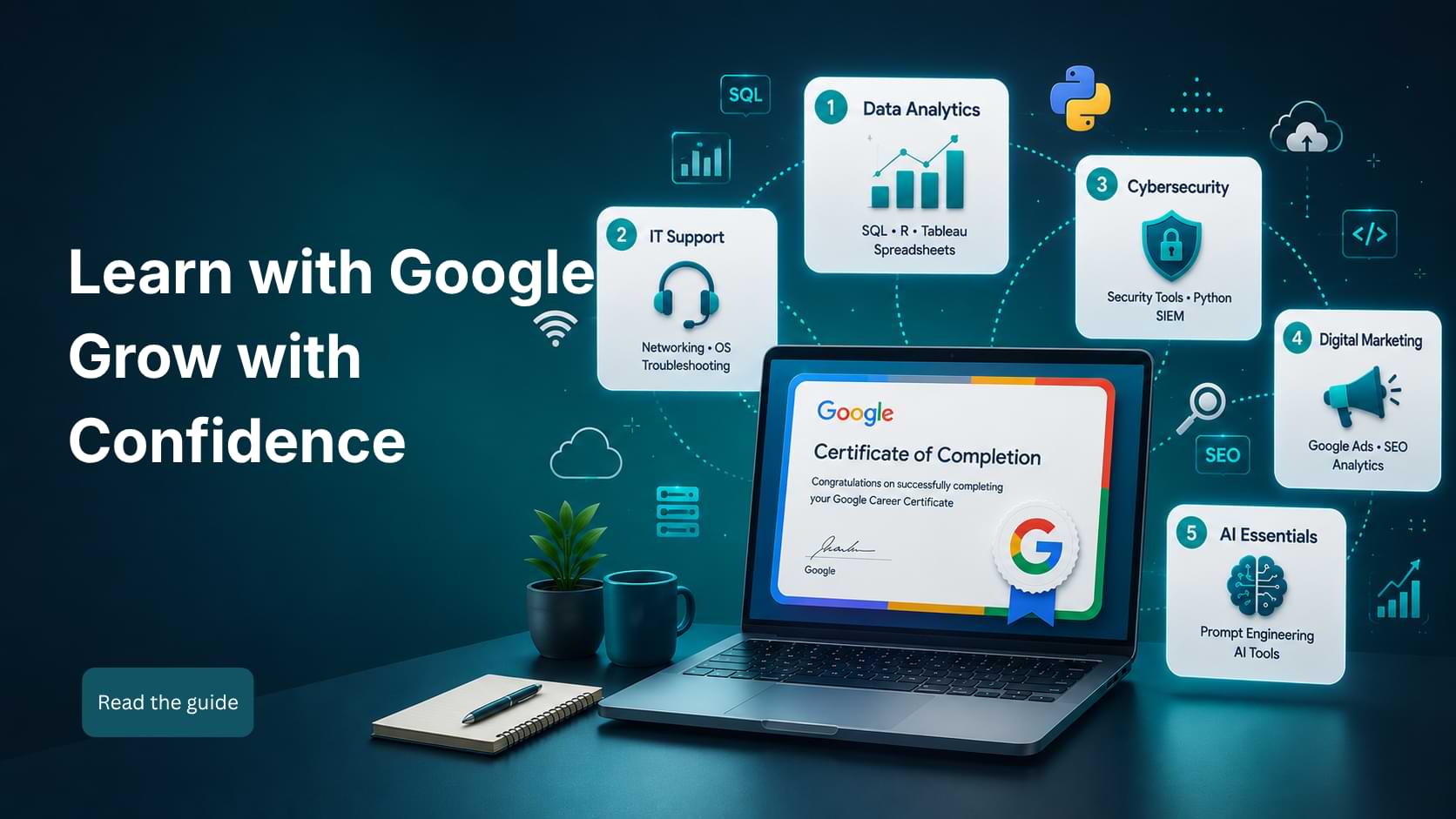
This blog does two things for you. Firstly, it provides you with an honest overview of the top-five most important free Google courses with certificates in 2026 – the courses worth your time and efforts in the rising IT market of Nepal. Secondly, it helps you understand the strategy which allows you to remain consistent and skilled in the time when AI changes everything, attention span becomes smaller and the gap between those who develop skills and those who pretend to do that grows every year.
Let us begin.
Why Google Certificates Matter More Than Most People Realize
Before we get into the list, there are some facts that are worth knowing.
It’s been said that Google considers its Career Certificates equal to a four-year degree program when making its hires. This isn’t just marketing jargon but Google’s official policy statement. Also, there are over 150 employers such as Deloitte, Infosys, Walmart, Verizon, Target, and Google itself which belong to the Google Career Certificates Employer Consortium, promising to consider the certificate holders for entry-level positions.
Google Career Certificates have also been recommended by the American Council on Education, ACE, with up to 15 college credits or five college courses at the bachelor’s level. Institutions like Northeastern University, Purdue University Global, and University of North Texas award college credits for earning Google Career Certificate.
The implication for Nepalese students is easy enough to understand: having Google certification on your resume, backed up by one or two actual projects, shows the employer that you have practical and verifiable skill rather than bookish knowledge.
Courses by Google are offered via Coursera. The usual cost of these is USD 49 per month. However, what most of these guides fail to mention is that Coursera provides financial aid, which makes these certifications completely free for those who qualify. Applying for it is easy, and there are high chances of approval for those who are truthful in filling up their application form about their finances. You can get your Google career certificate for free.
Now, these are the top five courses that are worth your while in 2026.
Course 1: Google Data Analytics Professional Certificate
- Platform: Coursera (via Google)
- Duration: Approximately 6 months at 10 hours per week (flexible, self-paced)
- Level: Beginner; no prior experience required
- Free Option: Apply for Coursera financial aid
- Direct Link: grow.google/certificates
What You Actually Learn
This happens to be one of the best structured introductory data courses offered by any provider. The whole data analysis process flow is covered from scratch.
Firstly, there are basics of data analysis – what exactly is data analysis, how data analysts think and work, and how data drives decisions in business organizations. After basics, there come tools from spreadsheets where raw data is collected and processed to SQL queries, R Programming, and visualization of data in Tableau and Google Data Studio.
In the end, one completes eight courses, performs hands-on labs and builds a capstone project.
Why It Matters in 2026
Data literacy is no longer an option but rather the standard requirement in virtually all professions. There has been a 414% increase in the job market for data analysts. In Nepal, where the technology sector is rapidly growing, many companies such as Verisk Nepal, Fusemachines, and startups associated with eSewa are currently recruiting for data positions.
This certificate course will provide IT enthusiasts in Nepal with an insight into what a career in the field of data science and machine learning looks like.Pair it with Knowlary's Data Science and Machine Learning course and you have both the certificate and the deeper technical skills that employers actually test for in interviews.
Skills You Build
- Data cleaning and validation in spreadsheets
- SQL querying and database basics
- R programming for data analysis
- Data visualization in Tableau and Google Data Studio
- Analytical thinking and problem framing
Best For
Students and beginners curious about data careers, BCA and BSc CSIT students who want a verified external credential, and anyone from a non-tech background who wants to enter the data world.
Course 2: Google IT Support Professional Certificate
- Platform: Coursera (via Google)
- Duration: 3 to 6 months at 10 hours per week
- Level: Beginner zero prerequisites
- Free Option: Apply for Coursera financial aid
- Direct Link: grow.google/certificates
What You Actually Learn
This is Google’s premier course, the first one which sparked the trend of IT companies issuing their own certifications. The course was taken by over 100,000 people worldwide and the results in terms of job placement were impressive.
The curriculum includes everything an IT support specialist needs to know — assembling computers, understanding computer hardware, setting up wireless networks, installing and configuring operating systems (Windows & Linux), IT system administration, troubleshooting techniques and IT support fundamentals, including the basic security measures.
The difference about this course lies in its practical approach — you do not only learn the theoretical material, but solve practical problems within the simulated environment of Qwiklabs assignments.
Why It Matters in 2026
It’s true that being an IT support and administrator may not be the most exciting job in the world, but they form the foundation of every IT business. Every single firm, whether it is a small fintech firm in Kathmandu or a multination in Lazimpat, requires individuals to take care of their systems. This is the perfect certification for recent graduates seeking a steady career path into Nepal’s IT market without having to code.
It also prepares you for the CompTIA A+ certification, one of the most widely recognized IT certifications globally which further strengthens your job prospects. Understanding the fundamentals here also directly supports your journey if you plan to transition into a tech career from a non-tech background.
Skills You Build
- Computer networking and hardware fundamentals
- Operating systems (Windows and Linux)
- System administration and troubleshooting
- IT security basics
- Customer service in technical contexts
Best For
Anyone entering IT without a technical background, students who want a verified credential before their bachelor's degree is complete, and people targeting entry-level IT support, helpdesk, or system administration roles.
Course 3: Google Cybersecurity Professional Certificate
- Platform: Coursera (via Google)
- Duration: Less than 6 months at 10 hours per week
- Level: Beginner no prior experience required
- Free Option: Apply for Coursera financial aid
- Direct Link: grow.google/certificates
What You Actually Learn
Cybersecurity has become one of the major skill shortages in the world's technology sector, with 3.1 to 3.5 million open jobs currently existing worldwide. The Google Cybersecurity Certificate has been designed specifically to tackle this problem.
Through eight courses, you will be able to understand how to recognize common risks, threats, and vulnerabilities, learn attacker mentality and tactics, utilize security information and event management (SIEM), employ incident response techniques, automate cybersecurity processes through Python programming, and get to grips with networking security basics.
The course content is very practical in nature. You will actually utilize the tools employed by real security analysts not virtual sandbox systems.
Why It Matters in 2026
In Nepal, the Cyber Resilience Guidelines of Nepal Rastra Bank have rendered cybersecurity a mandatory regulatory issue in the financial industry. The banking organizations, government organizations, and the technology firms are constantly looking out for cybersecurity experts and the availability of such individuals is far from meeting their demands.
The Google certification happens to be one of the easiest entryways to the profession, where the entry-level certified experts in Nepal earn NPR 50,000 to NPR 80,000 monthly, and the experienced experts earn NPR 1,50,000 to NPR 2,50,000 and beyond. This course in combination with practicing through free beginner labs available on TryHackMe platform really helps in building up a cybersecurity career from scratch.
Read more about how AI/ML and cybersecurity are shaping Nepal's tech job landscape to understand where this career path leads.
Skills You Build
- Risk identification and vulnerability assessment
- SIEM tools and log analysis
- Network security fundamentals
- Python for cybersecurity automation
- Incident detection and response
Best For
Students interested in security roles, IT professionals who want to specialize, and anyone who wants to enter one of the highest-demand and highest-paying IT fields in Nepal with a verified beginner credential.
Course 4: Google Digital Marketing and E-Commerce Certificate
- Platform: Coursera (via Google)
- Duration: Approximately 6 months at 10 hours per week
- Level: Beginner no background in marketing required
- Free Option: Apply for Coursera financial aid
- Direct Link: grow.google/certificates
What You Actually Learn
Digital marketing has become an entirely different thing in 2026. It’s more than running social media campaigns it's a whole new practice involving analytics, content creation, search engine optimization, paid digital marketing, email marketing, and online store management.
This certificate will teach you everything about digital marketing: how to develop a digital marketing strategy, how to set up and optimize Google Ads campaigns, what SEO and content marketing is, how to use Google Analytics, manage your social media accounts, run email campaigns, and how to market your product or service via e-commerce.
And you’ll do it all on real projects for your portfolio, not on some piece of paper.
Why It Matters in 2026
Among the many things that have been overlooked in terms of the intersection between digital marketing and AI in 2026 is the way these two fields overlap. The use of technologies such as AI-based advertising optimization services offered by Google, AI content generators, and automated analysis are part and parcel of any digital marketing toolset. Experts who can master both fields are much more valuable than their counterparts.
Nepal's booming business environment, which involves various kinds of e-commerce platforms, tech startups, and traditional businesses that go digital, requires an array of qualified digital marketing experts. Senior digital marketers with knowledge of data science and AI receive salaries ranging from NPR 80,000 to NPR 1,50,000 on a monthly basis, while freelancers get much higher salaries from international clients.
This certificate pairs directly with Knowlary's Digital Marketing Mastery course, which goes deeper into the AI-powered and Nepal-specific dimensions of digital marketing that the Google certificate does not cover in full detail.
Skills You Build
- Google Ads setup and optimization
- SEO strategy and content marketing
- Google Analytics and performance measurement
- Social media marketing and management
- E-commerce fundamentals and customer journey mapping
Best For
Students interested in marketing careers, entrepreneurs who want to grow their own business online, management and humanities stream students entering the tech-adjacent world, and anyone who wants to combine creativity with data in their career.
Course 5: Google AI Essentials (and Google AI Professional Certificate)
- Platform: Google Career Skills / Coursera
- Duration: AI Essentials: approximately 1 month; AI Professional Certificate: 3 to 6 months Level: AI Essentials no experience required; AI Professional beginner to intermediate
- Free Option: AI Essentials is free on Google Career Skills; AI Professional apply for Coursera financial aid
- Direct Link: grow.google/certificates
What You Actually Learn
This one happens to be the most recent addition to the list of certificates offered by Google. The AI Essentials course offers over 20 hands-on exercises on AI literacy, prompt engineering, responsible AI, generative AI tools, creating content with the help of AI, analyzing data with AI, and how to treat AI as a colleague instead of a gimmick.
The AI Professional Certificate program explores even further. It provides an overview of building AI projects, model deployment, using AI tools for professionals and building an AI project portfolio.
The difference maker here lies in its practical application. You don't just learn about AI – you learn how to apply it for getting more things done.
Why It Matters in 2026
The World Economic Forum estimates that 23% of all jobs will change significantly due to AI by 2027. AI fluency, the ability to use, understand, and work alongside AI tools effectively — is no longer a specialist skill. It is becoming the baseline expectation for professionals across all fields.
For IT aspirants in Nepal, AI literacy combined with technical skills creates an enormous competitive advantage. Companies in Kathmandu are actively looking for people who can leverage AI tools to accelerate development, automate workflows, and improve business outcomes. Understanding the future of AI and ML jobs in Nepal makes it clear that AI fluency is not optional for serious career growth.
And for those who want to go beyond AI literacy into genuine AI engineering, the foundation built here connects directly to Knowlary's Data Science and Machine Learning course, which covers the technical depth — Python, ML models, real data projects — that takes you from AI user to AI builder.
Skills You Build
- Prompt engineering fundamentals
- Using generative AI tools for content and design
- AI for data analysis and research
- Responsible AI principles and ethical considerations
- Building AI-powered workflows for productivity
Best For
Literally everyone. Students, professionals, career changers, entrepreneurs, managers, and creatives. AI literacy in 2026 is like computer literacy in 2000; it is not optional for anyone who wants to stay relevant.
The Quick Reference: All 5 Google Courses at a Glance
1. Google Data Analytics
- Duration: 6 months
- Key Skills: SQL, R, Tableau, spreadsheets
- Best For: Data careers, BCA/CSIT students
- Cost: Financial aid available
2. Google IT Support
- Duration: 3–6 months
- Key Skills: Networking, Operating Systems (OS), troubleshooting
- Best For: Entry-level IT jobs, career switchers
- Cost: Financial aid available
3. Google Cybersecurity
- Duration: 6 months
- Key Skills: Security tools, Python, SIEM
- Best For: Cybersecurity aspirants
- Cost: Financial aid available
4. Google Digital Marketing
- Duration: 6 months
- Key Skills: Google Ads, SEO, Google Analytics
- Best For: Marketing professionals, business students, entrepreneurs
- Cost: Financial aid available
5. Google AI Essentials
- Duration: 1 month
- Key Skills: Prompt engineering, AI tools
- Best For: Anyone who wants to build AI literacy
- Cost: Completely free
The Harder Part: How to Actually Stay Focused and Skilled in an AI-Driven World
This is the hard truth that is conveniently left out of most online learning guides.
Getting into an online class is easy. Completing an online class is the difficult part. Completion rates of online courses tend to hover somewhere between 5% to 15% globally. Which means that of the 100 individuals enrolled in a Google certificate, between 85% to 95% never complete the course.
The problem isn’t even the course. The course is fine. The problem is that the world of 2026 is constructed in such a way as to grab your attention from fifty different angles at once – notifications, social media, new courses coming up, the feeling of not having done enough, the feeling of too much choice.
Here’s how you do it anyway.
Strategy 1: The "One Thing" Rule — Ruthlessly
The largest error that people make when learning in 2026 is taking many courses at once. Python tutorials on Monday. Digital marketing on Tuesday. Attempt some React on Wednesday. And on Thursday you have forgotten what you learned on Monday.
Choose one course. Complete it fully. And only then begin the second course.
This may seem obvious but hardly anyone follows it. Students who manage to get Google certificates and learn anything useful from them are those who treat the course seriously, not as a smorgasbord of topics they can touch and move away.
Before even starting any course from this list, write down one sentence for yourself: "I'm doing this course because I want to [insert specific goal here] and I'm going to finish it by [insert specific date here]."
Strategy 2: Learn in Sprints, Not Marathons
Study sessions which are long and few are less effective than shorter sessions done regularly. This has been proven by a large amount of evidence gathered from studies in the field. Regular practice, even as little as 30 to 45 minutes per day, contributes more to your learning process than weekend marathons.
Set aside a minimum number of minutes per day that you can adhere to without fail. This shouldn’t be the maximum you want to but can’t. In case you feel that you can do 30 minutes every day after your studies or job, commit yourself to 30 minutes.
The portfolio building guide for Nepal has more on how to structure your learning time so that what you study actually converts into something you can show employers — not just knowledge that lives in your head.
Strategy 3: Build Something After Every Module
This is the single highest-leverage habit you can develop as a learner.
After every module not after the entire course, after every module spend 30 minutes trying to apply what you just learned to something real. Finished a SQL module? Write a query against a real dataset. Finished a Google Ads module? Create a mock campaign for a fictional business you invent. Finished a security module? Try a beginner challenge on TryHackMe.
Application after each module does two things. First, it locks in the learning in a way that passive watching never can. Second, it starts building your portfolio before you even finish the certificate. By the time you complete the course, you already have five or six mini-projects to show.
Strategy 4: Understand the AI Acceleration Trap
This is one particular thing about learning in 2026 that is being glossed over way too much.
AI can help you get through your assignments faster by generating code, writing essays, doing analysis, and solving problems. If you use AI to bypass learning altogether – by using it as an easy way to avoid having to do the work – you'll have a certificate but you'll have nothing else.
Use AI to augment your thinking, not to bypass it. Have it explain things that you don’t understand. Have it critique your work. Have it tell you why a piece of code is written the way it is. Don't have it do your work for you.
The people who will be succeeding in Nepal's IT industry in 2026 are not the ones who used AI to bypass their learning process. They are the people who went deep in learning, and used AI to speed up afterwards. Order is crucial here.
Read more about which in-demand tech skills Nepal's employers are actually testing for — understanding this will help you know exactly where genuine skill matters versus where surface-level familiarity is enough.
Strategy 5: Connect Your Learning to a Real Career Destination
The motivation level increases if learning is more relevant. Learning that is abstract "I am studying data analytics because it is significant" is much more difficult to motivate oneself into than learning that is connected. "I am studying data analytics because I am planning to intern at a data firm within this year, and a certification plus one project will help me achieve that goal."
Connect your Google certification to an internship, a certain kind of job description, or a freelance skill that you would like to learn. Check out the current job descriptions of jobs being advertised for Nepal's tech job board. See what kinds of skills they are looking for, and then target them using your Google certificate courses.
If you are a BCA student, read how BCA and BSc IT students can land data science internships. If you are a BSc CSIT student, read how to get an internship as a BSc CSIT student in Nepal. These guides turn abstract motivation into concrete action steps.
Strategy 6: Build Your Identity Around Learning, Not Outcomes
It may seem like philosophy. But it is the most practical thing on this list.
Those who start their training by concentrating all their attention on results "I need a job, I need some money, I need to learn this well" stop practicing when the process is slow, when a certain module becomes difficult for them, or when they see someone who already has three years of practice.
But those who build an identity of people who constantly improve themselves "I am the person who learns something new every day" keep practicing no matter how slow or quick this process seems to them. The certificate from Google is not what matters here. The daily improvement is what really matters.
One of the most overlooked resources for building this mindset and understanding how skills compound into a career is the Knowlary blog written specifically for Nepal's IT aspirants at every stage of their journey.
How Knowlary Fits Into Your Learning Journey
This is the truth about it.
Google certificates are wonderful to acquire credentials in core skills. Google certificates are organized, reliable, and internationally recognized. However, Google certificates are general and are made for international consumption, not for the Nepal market, Nepal IT industry, or career paths in Nepal.
This is where Knowlary's courses are built differently. Every program is designed around what Nepal's tech employers are actually hiring for — the specific tools, skills, and depth that gets you from a certificate to an actual job or internship in the Kathmandu tech ecosystem and beyond.
The Data Science and Machine Learning course at Knowlary takes you deeper than the Google Data Analytics certificate into Python, real ML models, and the technical depth that data science interviews actually test. The Digital Marketing Mastery course covers the Nepal-specific and AI-powered dimensions of digital marketing that the Google certificate treats only broadly. The Full-Stack Java Training and Graphics Design with AI course cover paths that Google's certificate portfolio does not touch at all.
The smartest learning strategy in 2026 is to use Google certificates to build foundation and signal credibility and use Knowlary to build the depth, specialization, and Nepal-market alignment that actually gets you hired.
A Final Note on Staying Skilled in an AI-Driven World
The rate at which changes occur in 2026 is actually quite rapid. New AI tools are being introduced weekly. Jobs are created which did not exist just two years ago. The skills that were considered to be groundbreaking in 2023 have become the basic requirements.
Under such conditions, the most risky move you could make would be to stop learning after having obtained one certification. The most effective move would be to develop the ability to learn continuously – treat your skills like a living organism that needs maintenance in order to remain relevant.
Those individuals who succeed in this environment are not those who put in the maximum effort into learning just once. They are the ones who appear consistently, learn consistently, create tangible products and never take a certificate for their end result.
The certificate is a key to the entrance. Your actions after it are the ones which keep that door open for you.
Take a course from this list. Apply for financial support today. Start working on your 30 minutes a day. Create something after each module. And keep doing it.
For more career guidance, tech skill deep-dives, and practical resources for IT aspirants in Nepal, explore the Knowlary blog and course library built for Nepal's growing tech generation.
Useful External Resources
- Google Career Certificates (Official): Enroll and apply for financial aid directly
- Google Digital Garage: Free short courses on digital skills, no subscription needed
- Google Cloud Skills Boost:Free cloud, AI, and data engineering training from Google
- Coursera Financial Aid Application: Apply here to access Google certificates for free
- TryHackMe: Free beginner cybersecurity labs to practice alongside the Google Cybersecurity certificate
- Kaggle: Free datasets and data science competitions to practice Google Data Analytics skills
- GitHub: Where to host and showcase every project you build during your certificate journey