
Meta Ads vs Google Ads: Which One Actually Gets You Results in 2026?
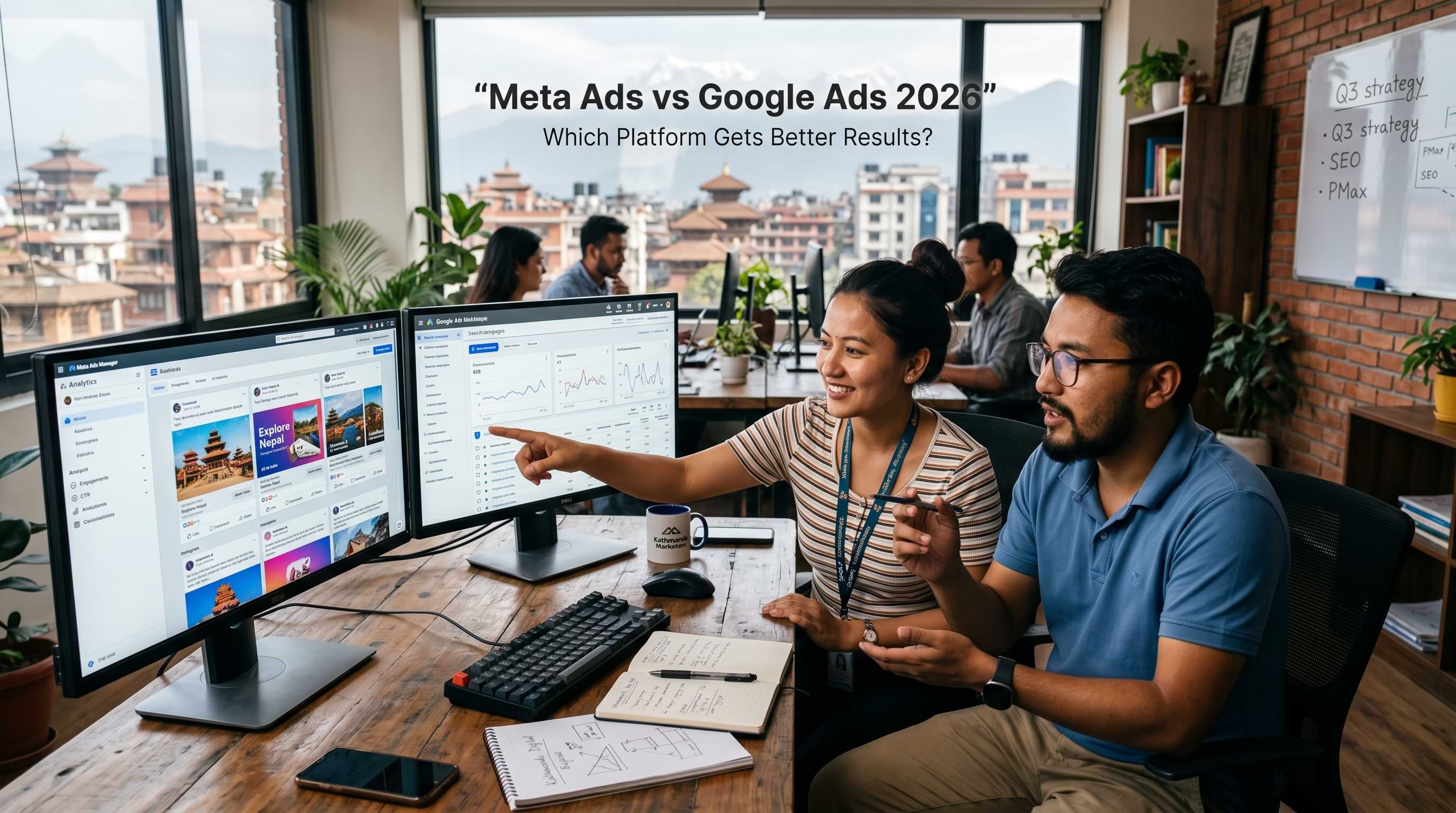
If you have ever opened an ads manager and looked at the screen wondering where you should spend your money you are not alone. Every marketer, every startup founder and every business owner will eventually face this decision. Should you use Meta or Google? Should you use Facebook or Search? Do you want to interrupt people or reach them when they have an intention?
This is not a simple comparison between Meta and Google. By the time you finish reading this post you will know exactly which platform is right, for your goal. You will understand how Meta and Google work and how to stop spending your budget on the platform.
What Are Meta Ads and Google Ads, Really?
Before we start talking about the battle let us understand what each platform is.
Google Ads is a way to show ads to people who are already looking for something. When someone searches for " marketing course in Nepal" on Google they are already interested in it. Your ad will show up at that moment when they are making a decision. This is what makes Google Ads so powerful. You get to meet people who're ready to buy something at the right time.
Meta Ads, which includes Facebook, Instagram, Messenger and WhatsApp work in a way. They show ads to people who are not necessarily looking for something. People are just browsing through their feed. Your ad shows up between videos of cats and updates from their family. Meta Ads use information about what people like. Who they are to decide who gets to see your ad.
Neither Google Ads nor Meta Ads is better than the other by default. They are used for things. And knowing the difference, between them is the most important thing you will learn from this article.
The Ads Manager: Meta vs Google
Both platforms have their ads manager dashboard and they are really different.
The Facebook ads manager, now called Meta Ads Manager focuses on audiences. You decide who you want to reach and the system finds them. You can target people by their age, where they live, what they like, their job title, if they are married or not and even big events in their life like "recently moved" or "new parent."
Google's Ads Manager is different. It focuses on keywords. What people want to do now. You figure out what people are searching for on Google. Your ad shows up when people search for those things. It is more about what people're trying to do at this moment, not who they are as a person. The Meta Ads Manager and Google's Ads Manager are two systems and they work in different ways. The Meta Ads Manager is about finding the right people and Google's Ads Manager is about finding the moment.
If you're running a course business ; like Knowlary's data science and full-stack programs both platforms have a role. Google captures students actively searching for courses. Meta builds awareness among people who don't yet know they need to upskill.
Exploring the Ads Library
One useful tool that not many advertisers know about is the ads library. And Facebook and other platforms have this tool.
The Meta ads library, which is also known as the Facebook ads library is a place to look at any Facebook Page and see all the ads they are currently running including what the ads say, the pictures and videos they use and when they were started. This tool is free for anyone to use it is public. You do not need to log in to use it.You can go to the Meta ads library called the Facebook ads library and start searching for Facebook Pages to see their ads.
Visit the Meta ads library, also known as the Facebook ads library at facebook.com/ads/library.
Why does this matter?
Because before you spend a single rupee or dollar, you can study what your competitors are doing, what messaging is resonating, and how long certain ads have been running (a long-running ad usually means it's profitable).
Google has a similar transparency tool called the Google Ads Transparency Center, where you can search advertisers by name and see their recent Search, Display, and YouTube ads.
Use both of these before you launch anything. It's free competitive intelligence most advertisers ignore.
Targeting: Where Meta Pulls Ahead
Meta's ability to target groups is really impressive but its also the feature that sparks the most debate. The platform has collected an amount of data on how people behave across Facebook and Instagram over the years. This allows you to create audiences based on things, like:
- Demographics: age, gender, location, language
- Interests: topics users engage with regularly
- Behaviors: purchase behavior, device usage, travel habits
- Custom Audiences: upload your email list and target those exact people
- Lookalike Audiences: find new people who resemble your best customers
For companies that want to make people know about their brand or focus on a group of people like students studying Bachelor of Computer Application in Kathmandu who want to work in technology, Meta is very good at helping them reach these people.
Google does things a bit differently. When you use Google you are targeting what people are searching for, not the people themselves.. Google also has a feature called audience layering, which means you can add filters like what kind of people you want to reach or what they are interested in on top of targeting specific keywords to make sure your message gets to the right people.
Cost and ROI: The Honest Picture
There is no one answer to the question of which platform's cheaper. However, here are some general things to consider.
Google Ads usually costs more per click because you are competing with companies when someone wants to buy something. This can be really expensive in areas like finance or law.. If you are selling something that not many other people are selling it can be pretty cheap.
Meta Ads are usually cheaper per click. They might not work as well because you are showing your ads to people who are just browsing, not looking to buy. How well your ads work depends a lot, on how good they're
So here is an idea: if you are selling something that people look for you should start with Google Ads. If you are selling something that people do not know they want or if you want people to remember your company you should start with Meta Ads.
For education businesses, a blended approach works best — Google for high-intent searches like "graphic design course with AI" (which Knowlary offers at knowlary.com/courses/01_graphics-design-with-ai), and Meta for retargeting visitors who didn't convert the first time.
Ad Formats: Creative Flexibility
Meta Ads offer a rich variety of formats:
- Single image and video ads
- Carousel ads (multiple images users can swipe through)
- Stories and Reels ads
- Collection ads for e-commerce
- Instant Experience (full-screen mobile landing pages)
Google Ads cover an equally wide surface area:
- Search ads (text-based, appear on Google Search)
- Display ads (visual banners across millions of websites)
- YouTube video ads
- Shopping ads (product listings with images and prices)
- Performance Max campaigns (AI-driven, runs across all Google surfaces)
There is one thing that's really worth thinking about. Google ads that you see on YouTube are very good for businesses that teach people things. If you have an ad that people cannot skip before a video that teaches them something it can be a great way to get your course in front of the people who are most likely to be interested in it. Google ads on YouTube are really powerful for education businesses, like this.
When to Use Meta Ads
Use Meta Ads when you want to:
- Build brand awareness with a new audience
- Retarget website visitors who didn't convert
- Promote content like blog posts, videos, or lead magnets
- Reach a specific demographic (age, city, interest)
- Run lower-budget campaigns with high creative testing
- Sell visually appealing products or services
When to Use Google Ads
Use Google Ads when you want to:
- Capture people actively searching for what you offer
- Drive conversions from high-intent queries
- Advertise locally (plumbers, restaurants, clinics)
- Run YouTube video campaigns
- Remarket to previous visitors across the web
- Scale a proven offer in a competitive market
The Smarter Play: Use Both
The best advertisers do not just pick one. They create a plan that uses both.
- Top of the plan: We use Meta Ads, like video and image ads to reach people who do not know about our product yet.
- Middle of the plan: We target people who already know about our product with ads on Meta and Google.
- Bottom of the plan: We use Google Search Ads to reach people who're ready to buy.
If you are studying or just starting your career in Nepal and want to get into marketing you need to understand this plan. You can find out more about the tech skills that're, in demand right now from the Knowlary blog — particularly this piece on in-demand tech skills in Nepal which covers what employers are actually hiring for.
Measuring What Matters
Both Meta and Google have tools to measure things but they do it in different ways.
Meta looks at what people do on your website after they click on or see an ad. The problem is that Apple made some changes to privacy on iPhones, which has made Meta's information not good since 2021. Now Meta has to make some guesses to fill in the missing information, which means the numbers they say might not be the same as what happens.
Google is usually better at measuring things for search ads because it is connected to what people click on and what they do on your website. For YouTube and the other ads that Google shows the numbers can get bigger than they really are or like what happens with Meta.
Best practice: Use Google Analytics 4 as your neutral source of truth, with UTM parameters on all your ad URLs so you can see actual traffic and conversions from each platform independently of their native dashboards.
Conclusion
Meta Ads and Google Ads work together not against each other. The big question is not which one is better. It is which one suits your goal, budget and audience. If you are just starting out use Google Search Ads to get conversions and Meta Ads to create awareness.If you are growing use both Google Search Ads and Meta Ads with a proper plan.
As a marketer, in Nepal you need to know both Meta Ads and Google Ads. It is no longer a choice. The job market for digital marketers in Nepal increasingly expects fluency in both ecosystems, especially as businesses in Kathmandu and beyond shift more budget online.
To be a digital marketer, in 2026 you need to know about ads. You need to know how ads work and how they are targeted at people. It is also important to know how people block ads. Knowing all this about ads is part of the job of a marketer. Digital marketers need to understand ads.
Want to build a career in digital marketing or tech? Explore Knowlary's courses at knowlary.com/courses and read career guides for students on the Knowlary blog.